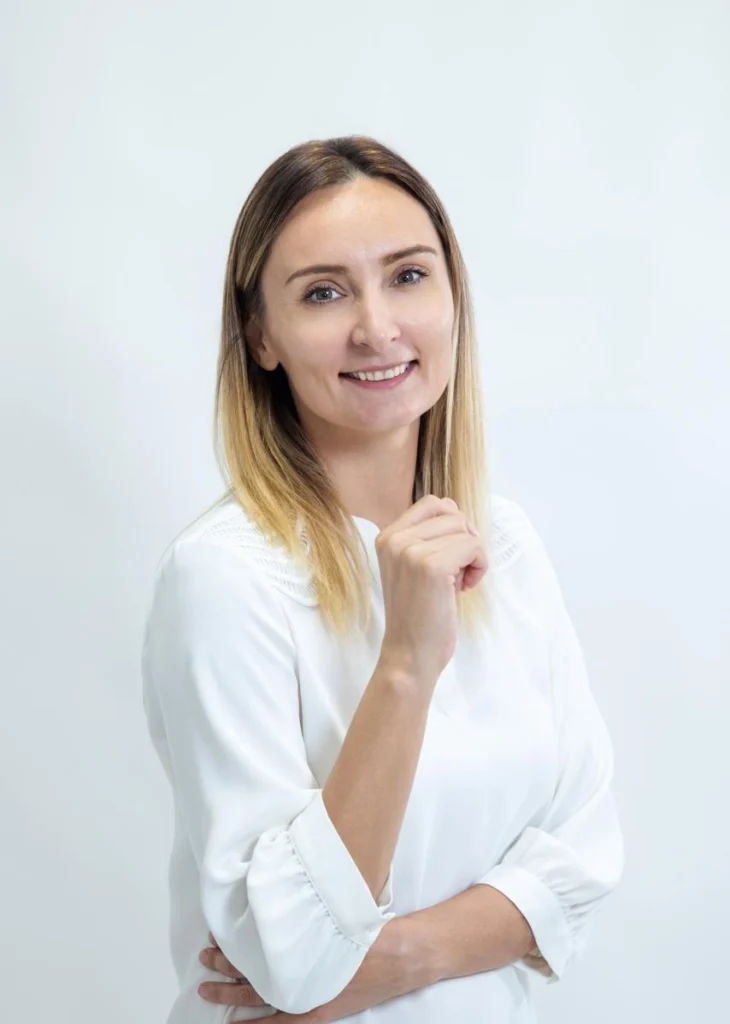
Patricia Urquiola was born in 1961 in Oviedo, a city located in northern Spain. She has Basque, half-Asturian blood, which, according to the designer, defines her personality and partially contributes to her success.
She studied first in Madrid and then in Italy, where in 1989 she graduated from the Polytechnic Institute of Milan and defended her dissertation on needlework by Achille Castiglioni.
From 1990 to 1992, she taught as an assistant professor at the Polytechnic Institute of Milan and at the Ensci (National Graduate School of Industrial Design in Paris). During the same period, she collaborated with the Italian company Maddalena De Padova, where she met another great Italian, Vico Magistretti, with whom she designed several items — the Flower chair, the Loom sofa and the Chaise Longue horizontal chair. Like Achille Castiglione, Magistretti highly appreciated the potential of the young designer, and the recommendations of such “whales” are a ticket to the world of large industrial design.
From 1993 to 1996, she worked in the Castiglioni working group, together with other designers and architects, took part in architectural projects, interior design and decoration of exhibition pavilions. Since 1998, she began cooperation with Moroso, a manufacturer of upholstered furniture.
From 1996 to 2000. Patricia Urquiola heads the development department of Lissoni and Associates (a company created by Piero Lissoni. In 2001, she opened her own design and architecture studio. He gives lectures on “Exhibition Design”, Shop vision at Domus Academy, and also conducts seminars on “Home Design”.
Her professional activity is based on numerous partnerships in the field of design and architecture with companies of global importance — Moroso, Lissoni Associati, Agape, Alessi, B&B, De Padova, De Vecchi, Driade, Foscarini, Kartell, MDF, Molteni, San Lorenzo, Knoll, Marks and Spencer, Sand, Somma, Roberto Torretta.
The furniture created by Urquiola is difficult to characterize and describe in any way. She doesn’t match any fashion style and doesn’t shout “Designer!”. Instead, Patricia’s furniture is distinguished by excellent quality, conscious context, thoughtfulness of every detail, elegant simplicity and homely comfort.
An original approach to traditional things, the search for new solutions, the ability to make manufacturers believe in her idea are the concepts that characterize the work of Patricia Urquiola.
Patricia Urquiola works in harmony with the highest academic standards, taking into account that any industrial designer unwittingly influences the emotional perception of the consumer. It’s a big responsibility, and she’s doing a great job with it.
“Women add more common sense to design. The future of design is in the absence of symmetry. If the right half of the chair resembles the left, life stops. Furniture should be separated from us and represented as a part of the big world.”
“I don’t just draw a lamp or a chair, but immediately imagine the context in which this object will appear. Every object needs a plot. The object should attract a person: you need to come up, sit or lie down, but be sure to “chat”, only then there will be even more interest in this or that model. So the expression “it’s just here for furniture” is no longer relevant. Modern furniture requires “communication”.
“Every object is seductive, arouses curiosity, attracts attention. When you want to make an elegant thing, you need to see its style, its image in advance. You need to be very careful and invest a lot in creating things in order for each object to be excellent. People believe in me and my work, and it’s important to me how they perceive and accept what I’ve created.”
“Every object is seductive, arouses curiosity, attracts attention. When you want to make an elegant thing, you need to see its style, its image in advance. You need to be very careful and invest a lot in creating things in order for each object to be excellent. People believe in me and my work, and it’s important to me how they perceive and accept what I’ve created.”
“I love transparency. A surface through which you can look, but not glass. B&B asked me to make a table out of glass, and I said: “God, I don’t like glass tables, people are always looking at what’s going on under the glass.” So we used a lens material that looks like bottle glass, it’s a little dark, a little pop, a lot of things.”
“I care about how the item I made will be used. It is important for me that this object attracts a person to such an extent that he comes up, tries to sit or lie on it and that this “communication” creates even greater interest in the model.”